The True Cost of IT Downtime
Lewis Hancock
October 28, 2025
Your server goes down. The internet cuts out. Your critical application won't load. What's the first thought that goes through a business owner's mind? "How long until this is fixed?"
Most businesses see downtime as a temporary pause. But the reality is that every minute your systems are offline, you're not just waiting—you're losing money. The true cost of IT downtime goes far beyond the obvious, seeping into every corner of your operation.
Let's break down what an IT outage *really* costs your business, from the visible damage to the hidden expenses.
These are the costs you feel immediately. They are the easiest to measure and the most painful in the short term.
This is where the true financial damage lies. These costs are harder to quantify, but their long-term impact is often far greater.
This is the single biggest hidden cost. It's not just that employees stop working during the outage. The cost multiplies:
This cost is devastating. While you're offline, your customers are not.
Constantly battling bad technology is exhausting and frustrating. Top talent wants to work with efficient tools. If your team spends more time waiting for tech than using it, your best employees will leave. The cost of hiring and training a replacement is a massive, indirect cost of downtime.
You don't need a complex algorithm to get a good estimate. Here’s a simple, conservative formula you can use right now.
There are two main parts to your calculation: Lost Productivity and Lost Revenue.
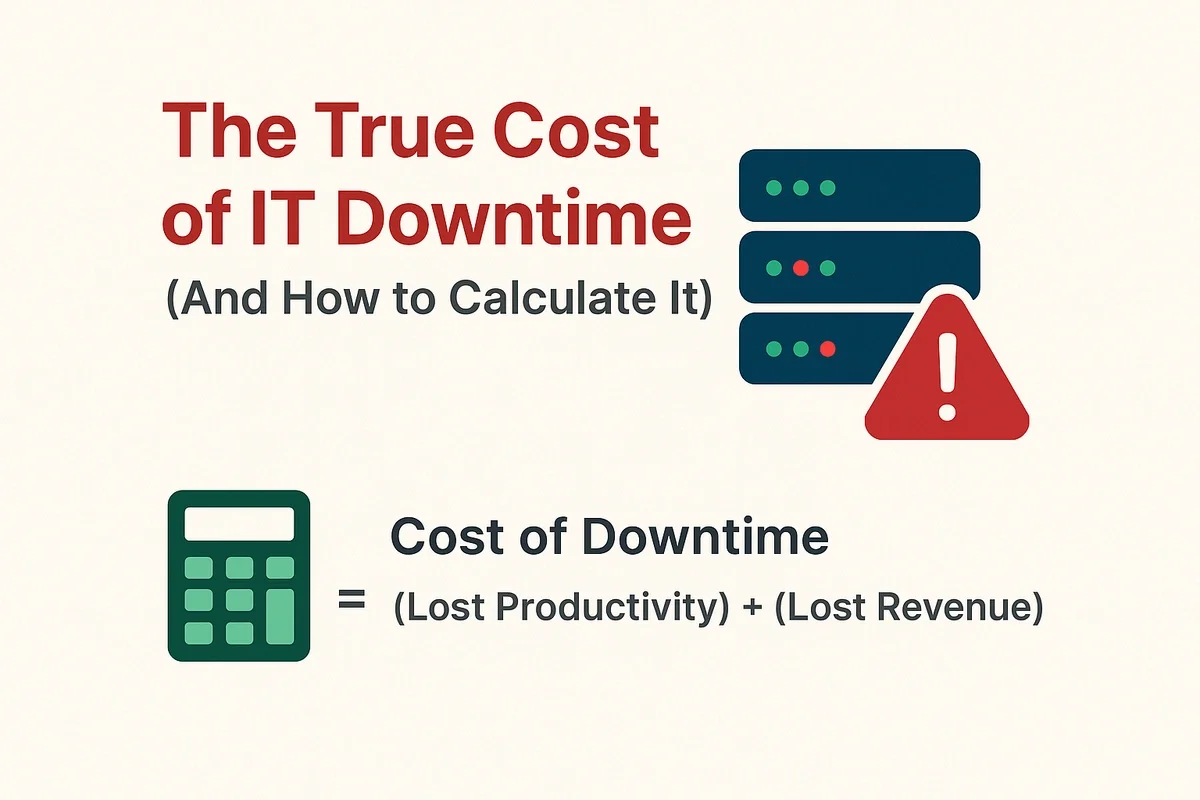
Cost of Downtime = (Lost Productivity) + (Lost Revenue)
1. Lost Productivity:
(Number of Employees) x (Avg. Employee Cost/Hour) x (Hours of Downtime)
2. Lost Revenue:
(Total Annual Revenue / 2080 Work Hours) x (Hours of Downtime)
Let's run an example:
Imagine a 20-person company with $5M in annual revenue and an average employee cost (salary + benefits) of $40/hour. They experience a 2-hour outage.
Total Cost for a 2-Hour Outage: $6,407
That's over $6,400 for two hours of "just waiting." And this doesn't even include the un-quantifiable costs like reputation damage.
For decades, the standard IT model was "break-fix": when something breaks, you call someone to fix it. As you can see from the calculation above, this model is a financial disaster. By the time you make the call, you've already lost thousands.
The solution is a proactive, managed IT approach. This is the core of what we do at Riverside Technologies.
An investment in proactive IT isn't a cost—it's insurance. It’s the difference between preventing a problem and paying to clean one up.
How much is downtime costing you? Let's find out. Contact Riverside Technologies for a free, no-obligation downtime cost analysis for your business. We'll show you exactly where your risks are and how a proactive plan can save you money.
Schedule Your Free Cost Analysis TodayLet Riverside Technologies help your business with comprehensive IT solutions.
Contact Us Today